
Introduction: A New Era of Visual Artificial Intelligence
Artificial Intelligence is no longer just about text generation or smart chatbots. The world has now stepped into the phase of visual reasoning and creativity, and leading this evolution is the highly talked-about Nano Banana AI, the next-generation image generation and editing system recently unveiled under Google’s Gemini 2.5 Flash Image program.
The newest version of Nano Banana AI is not only faster and more realistic but also far more contextually aware. It can modify or generate high-resolution images directly from natural-language prompts, maintain identity consistency, and produce creative yet lifelike results that are almost indistinguishable from real photographs.
But as the technology gets smarter and more accessible, ethical questions, privacy concerns, and professional risks are rising. From potential misuse of personal photos to the fear of job displacement in creative industries, Nano Banana AI opens both opportunities and moral dilemmas for society.
In this 4-part deep-dive series, we’ll analyze everything about the latest Nano Banana AI version — from its powerful new updates to its most pressing ethical implications.
What Is Nano Banana AI?
Nano Banana AI (popularly known as Gemini Nano Banana) is an AI-driven image generation and editing model created by Google DeepMind’s Gemini team. It works as an all-in-one visual creation tool, enabling users to:
- Generate new images from text prompts.
- Edit existing photos using natural-language instructions.
- Create realistic portraits, artistic visuals, and commercial imagery.
- Integrate with Google tools like Gemini app, Google Lens, and AI Mode.
Unlike older versions, the latest 2025 release brings unprecedented accuracy, realism, and ethical safety features — making it one of the most advanced and responsible AI image models to date.
What’s New in Nano Banana AI Latest Version (2025)
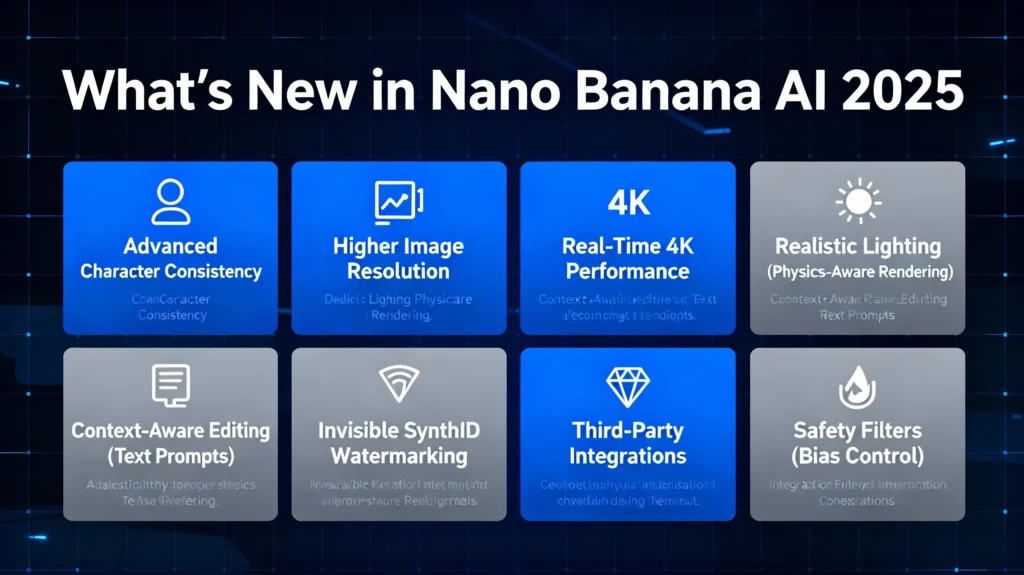
The Nano Banana AI update comes with a powerful suite of technical and usability enhancements that redefine how creators interact with generative AI.
1. Advanced Character Consistency
Earlier AI tools often struggled to maintain identity across edits — a person’s face or outfit would subtly change each time. The new version solves this using deep identity embedding, preserving fine details even after multiple transformations. This is critical for designers, advertisers, and filmmakers who require continuity.
2. Higher Resolution and Faster Performance
The Gemini 2.5 Flash Image engine can now process and generate 4K-ready images at almost double the speed of previous models. Real-time editing on mobile is smoother, with better detail in textures, lighting, and reflections.
3. Realistic Lighting & Physics-Aware Rendering
Nano Banana’s new physics-aware rendering engine simulates light behavior realistically — objects cast accurate shadows and maintain color consistency with surroundings. This is a leap forward from older “flat” AI visuals.
4. Context-Aware Editing
The AI can interpret context clues from the image — if you tell it “make this photo look like it’s evening,” it adjusts shadows, sky tone, and ambient color automatically. This contextual editing eliminates the need for manual color correction.
5. SynthID Watermarking for Ethical Transparency
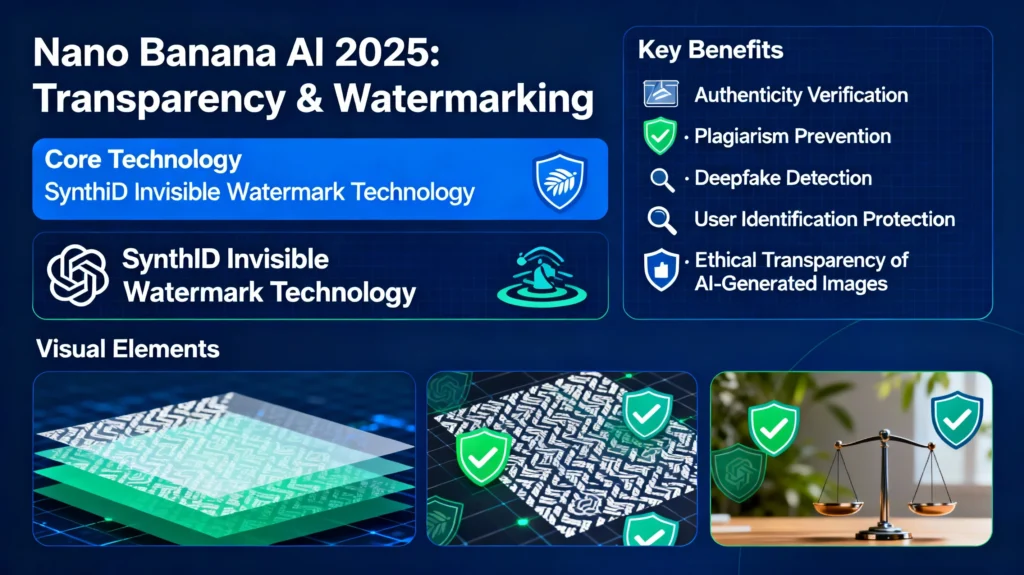
Every image generated or edited through Nano Banana now carries an invisible digital watermark called SynthID, ensuring that AI-generated content can be authenticated later. This protects creators from plagiarism and helps platforms combat deepfakes.
6. Third-Party Integrations
Nano Banana AI is gradually integrating with Photoshop beta, Google Drive, and Canva Labs, making it easier for professionals to include AI generation in their daily workflow.
7. Safety Filters & Bias Control
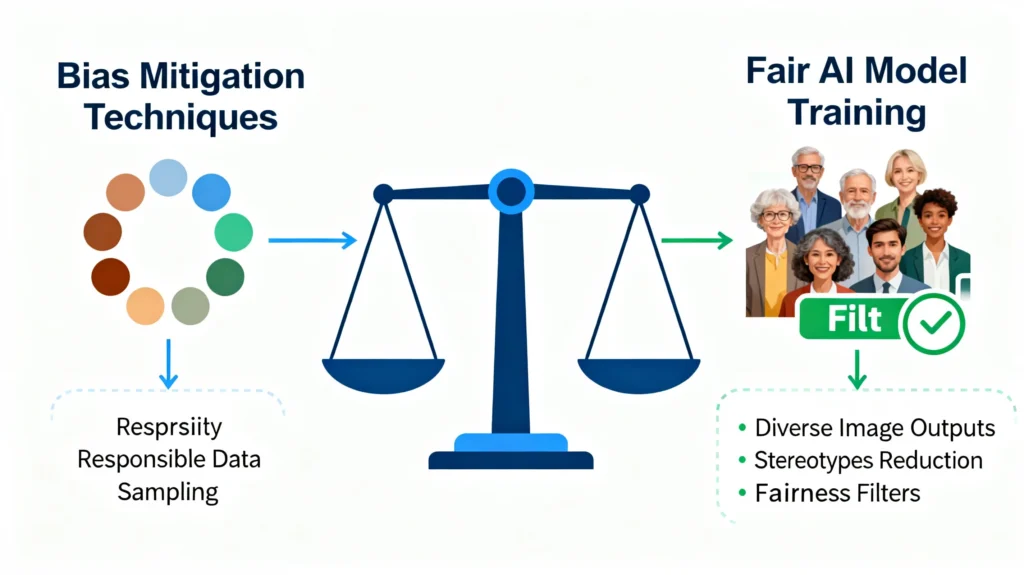
One of the biggest criticisms of older AI models was racial and gender bias in outputs. Nano Banana’s new bias-control framework reduces stereotypical imagery and promotes diversity by balancing training datasets and applying fairness constraints.
Why Nano Banana AI Matters Now
The new Nano Banana is more than a design tool — it’s a socio-technological phenomenon. Millions of users on social media have already used it for portrait stylization, professional branding, and even virtual product modeling.
However, its arrival has reignited debates about AI ownership, privacy rights, and the displacement of human creativity.
Let’s explore each aspect deeply in this series, beginning with the most urgent issue — data privacy.
The Privacy Question: How Safe Is Your Data?
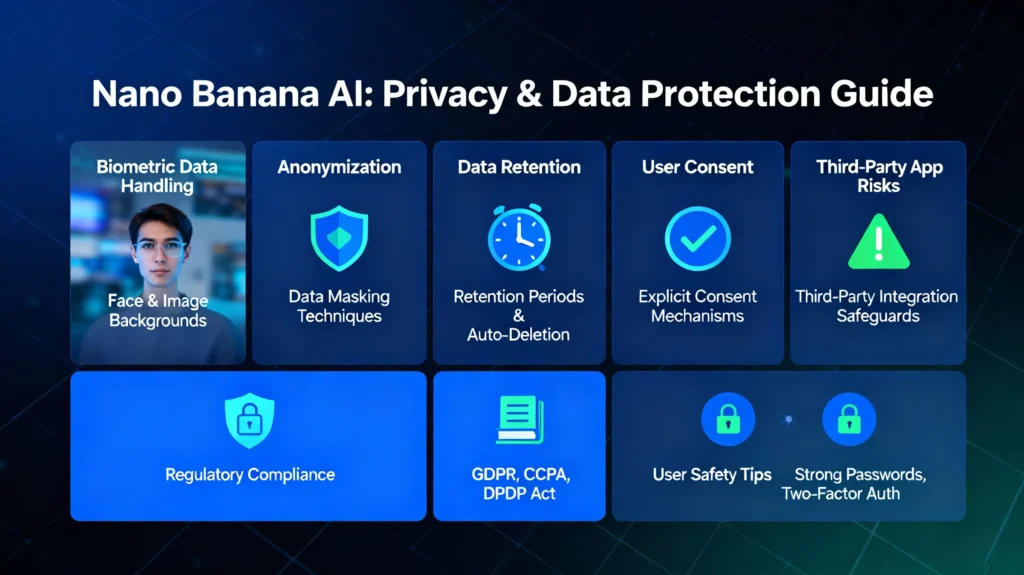
Whenever users upload images to any AI system, they’re sharing intimate data — their face, location, background items, and sometimes metadata that reveals where the photo was taken.
1. Biometric Information and Model Training
Each uploaded face is technically a form of biometric data. If stored or reused for model improvement, it could identify you later. Nano Banana claims to anonymize and delete such inputs, but independent audits remain limited.
2. Data Storage & Retention
While Google’s transparency pages assert compliance with privacy laws, the actual retention periods for training data are not public. Long-term storage poses risks of unauthorized access or internal misuse.
3. Third-Party Integrations
Once Nano Banana connects with external apps like Canva or Photoshop, your photos may be temporarily stored on those platforms. Each integration introduces its own privacy policy — a potential loophole for data leakage.
4. Regulatory Compliance
Under laws such as GDPR, CCPA, and India’s DPDP Act, AI platforms must obtain explicit consent before processing biometric data. Still, “click-to-agree” terms rarely make users truly aware of what’s happening behind the scenes.
5. Practical User Tips
- Avoid uploading sensitive or confidential images.
- Read the app’s privacy policy — look for phrases like “data retention,” “training use,” and “third-party access.”
- Opt-out of model improvement if available.
- Delete old prompts or images after use.
Ethical Risks: Bias and Misrepresentation
Despite technological safeguards, algorithmic bias remains a persistent challenge.
1. Skewed Representation
AI often over-represents Western facial features, fashion, and cultural backdrops. In contrast, minority communities get under-represented or stereotyped outputs.
2. Cultural Homogenization
By normalizing a single global aesthetic, AI visuals can unintentionally erode local art styles and traditional beauty standards — a subtle but deep cultural risk.
3. AI as a Mirror of Society
Nano Banana doesn’t create bias — it mirrors existing data patterns. Therefore, ethical AI development must start with responsible dataset curation and bias auditing.
Job Displacement: The Next Wave of Automation
1. Industries Most at Risk
- Stock photography & micro-content creation.
- Basic photo retouching services.
- Advertising mockups and concept illustrations.
2. Augmentation Instead of Replacement
While repetitive tasks may vanish, creative direction, concept storytelling, and emotion-driven design will continue to require humans. AI is a tool of acceleration, not annihilation — if used wisely.
3. New Opportunities
Professionals who master prompt engineering, AI visual supervision, and synthetic data curation will define the next decade of digital creativity.
Responsible Use of Nano Banana AI
- Always disclose AI-generated content — mention it in captions or metadata.
- Respect privacy — do not generate images of real people without consent.
- Avoid harmful or misleading outputs — no deepfakes, defamation, or fake news.
- Support ethical AI research by reporting bias or offensive outputs.
Nano Banana AI (Part 2): Ethical Governance, Data Transparency & Bias Auditing in 2025
Introduction: Why Ethics Matter More Than Ever
Artificial Intelligence has reached a point where its moral compass matters as much as its processing power. With the launch of Nano Banana AI, Google has once again shown what visual generative models can do — turning text prompts into stunningly realistic images, artworks, and visual stories.
But behind every powerful algorithm lies an invisible web of ethical questions — about fairness, consent, bias, transparency, and accountability. In this part of our deep-dive series, we explore how ethical governance around Nano Banana AI is evolving in 2025, what global frameworks are being discussed, and how developers and users can ensure responsible AI usage.
1. Understanding Ethical Governance in AI
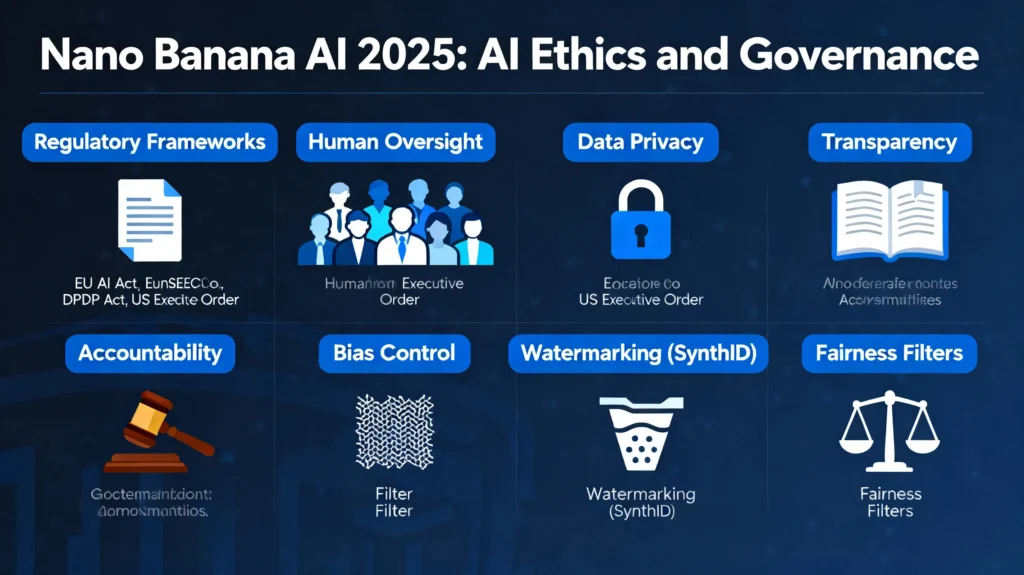
1.1 What Is AI Governance?
AI governance refers to the systems, laws, and principles that define how AI should be designed, used, and regulated. It includes:
- Transparency and explainability of models
- Data collection ethics and user consent
- Accountability for harm or bias
- Compliance with regional data protection laws
For tools like Nano Banana AI, ethical governance isn’t just a theoretical concept — it directly influences how the tool interacts with billions of users’ images and data.
1.2 The Ethical Dilemma Behind Innovation
AI innovation always runs ahead of regulation. By the time policymakers draft laws, the technology often evolves again.
Nano Banana’s rapid rollout illustrates this tension — the AI community celebrates its realism, while privacy advocates warn about blurred ethical boundaries.
The dilemma:
How do we allow innovation without compromising on privacy, fairness, and human dignity?
2. The Global Ethical Frameworks Guiding AI
As Nano Banana and similar models go mainstream, several global and national frameworks are emerging to guide responsible AI practices.
2.1 UNESCO’s AI Ethics Recommendation
In 2023, UNESCO’s 193 member countries adopted the Recommendation on the Ethics of Artificial Intelligence.
Its principles directly apply to systems like Nano Banana:
- Human oversight: Humans must remain in control of decision-making.
- Transparency: AI systems should disclose their artificial origin.
- Data privacy: Personal and biometric data require explicit consent.
- Accountability: Developers must be answerable for ethical breaches.
If strictly followed, this would mean Nano Banana must clearly label AI-generated content (via SynthID) and never store user faces without explicit consent.
2.2 The EU AI Act (2025 Update)
The EU AI Act, finalized in 2025, categorizes AI tools by risk level:
- Minimal Risk: Chatbots, entertainment AIs.
- Limited Risk: Content recommendation tools.
- High Risk: AI systems processing biometric or identity data.
Nano Banana, being an image generator capable of editing real human photos, falls close to the High-Risk category due to potential biometric misuse.
This means strict requirements like:
- Documented dataset sources.
- Impact assessments for bias and discrimination.
- Explicit user consent for any biometric use.
2.3 India’s DPDP Act & AI Code of Ethics
India’s Digital Personal Data Protection (DPDP) Act, 2023, is shaping how platforms like Nano Banana must handle user images.
The proposed AI Code of Ethics (2025 Draft) further pushes for:
- Transparent data collection notices.
- Local storage of Indian users’ biometric data.
- Mandatory labeling of synthetic media.
If adopted widely, Indian users could soon see AI-generated watermark indicators or “AI content” tags automatically applied by default.
2.4 The U.S. Executive Order on AI (2024)
The U.S. framework emphasizes AI safety testing, bias audits, and watermarking for deepfake prevention.
For Nano Banana, this aligns directly with its SynthID watermark — a technical response to the policy requirement for content authenticity.
3. Nano Banana’s Built-in Ethical Mechanisms
3.1 SynthID — The Invisible Digital Signature
Every Nano Banana image carries a hidden digital watermark called SynthID, embedded at the pixel level.
It’s invisible to human eyes but can be detected by Google’s verification tools to confirm whether an image is AI-generated.
Why SynthID Matters:
- Transparency: Users know if content is synthetic.
- Accountability: Helps trace misuse or deepfakes.
- Regulatory Compliance: Meets emerging laws demanding provenance verification.
However, as researchers note, watermarks can be stripped or altered — meaning that policy enforcement must go hand-in-hand with technology.
3.2 Safe Data Pipelines
Google claims Nano Banana’s data pipeline uses “data minimization” — meaning only essential data is processed and temporary caches are cleared.
Yet, skeptics argue that model training might indirectly retain traces of personal data.
Ethical governance must therefore include external audits and transparency reports about training datasets.
3.3 Bias Control and Fairness Filters
One of Nano Banana’s standout ethical upgrades is its bias-control layer, which:
- Detects demographic or gender imbalance in generated results.
- Randomizes training data exposure to ensure equal representation.
- Reduces stereotypical patterns (e.g., associating specific roles with specific genders).
This is part of a larger trend where AI models are regularly audited for fairness, using both statistical metrics and human review panels.
4. The Reality of Bias in Generative Models
Even with fairness layers, no AI is bias-free.
Nano Banana’s visual bias often reflects the dominant cultural patterns found in its training data.
4.1 Case Study: Gendered Representation
When prompted with “a professional engineer,” many early AI systems predominantly showed male figures.
Nano Banana has improved, but subtle patterns still persist — such as gendered color tones, posture, or clothing cues.
4.2 Cultural Representation Bias
Prompts like “traditional Indian wedding” may still reflect limited regional diversity (e.g., overemphasis on North Indian attire).
Such skew reveals dataset imbalance, not intentional bias, but still affects cultural accuracy.
4.3 Socioeconomic and Racial Bias
Generative AIs can unintentionally reinforce stereotypes about economic class or race. For example:
- “A successful entrepreneur” → primarily Western visuals.
- “A poor farmer” → dark-toned, rural imagery.
Bias mitigation must therefore involve continuous dataset auditing and inclusive retraining — something Nano Banana claims to pursue actively.
5. Transparency and Explainability
Transparency is the foundation of AI trust. For Nano Banana, that means users should understand:
- What data is being used.
- How edits are made.
- What safety layers are active.
5.1 Transparency Reports
Google periodically releases transparency reports on Gemini and related AI projects, highlighting improvements and risk mitigations.
For true accountability, these reports must become auditable by third parties, not just internal reviews.
5.2 Explainable AI (XAI) in Visual Systems
Nano Banana incorporates explainable AI features — allowing users to view “why” a particular edit or suggestion was made.
For example, when changing lighting or style, the AI can provide short rationales such as:
“Adjusted contrast to match evening tone requested.”
These micro-explanations improve user trust.
6. The Role of Independent Auditing
Independent AI audits are becoming the gold standard for credibility.
6.1 What Is an AI Audit?
An AI Audit is a third-party examination of how fair, transparent, and safe an AI model is. It checks:
- Dataset diversity
- Bias in output results
- Security & privacy safeguards
- Environmental impact (training energy footprint)
6.2 How Nano Banana Could Be Audited
For a system as large as Nano Banana, auditors would:
- Sample large volumes of outputs across demographics.
- Measure statistical fairness (e.g., representation ratios).
- Analyze metadata handling for privacy.
- Review algorithmic transparency documentation.
Such audits ensure ethical accountability — something regulators may soon make mandatory.
7. Real-World Ethical Incidents & Lessons
7.1 The “Face Swap” Controversy
Soon after Nano Banana’s beta launch, users began testing face replacement prompts.
While fun, it sparked ethical alarms about identity misuse and deepfake potential.
This pushed Google to enforce stricter content filters — blocking realistic impersonation attempts.
7.2 The Viral “Fantasy Portrait” Trend
Millions of users uploaded selfies for stylized edits. Experts later warned about biometric risks — as these photos could train future models.
Lesson: Popularity doesn’t erase privacy obligations. Transparency is essential.
8. How Users Can Be Ethically Responsible
Ethical governance isn’t only for tech giants — users play a role too.
8.1 Responsible Prompting
Avoid prompts that:
- Recreate real individuals without consent.
- Generate sensitive or defamatory imagery.
- Exploit gender, race, or religion stereotypes.
8.2 Transparency in Publishing
If you publish AI-generated visuals (on websites, social media, or ads):
- Label them clearly (“AI-generated with Nano Banana”).
- Include alt-text for accessibility and transparency.
- Avoid misleading the audience about authenticity.
8.3 Reporting Bias or Misuse
Most AI platforms, including Nano Banana, now allow direct reporting of biased or harmful outputs.
Active community participation strengthens ethical feedback loops.
9. The Future of Ethical AI Design
9.1 Towards Human-Centered AI
Ethical design means placing human benefit above algorithmic performance.
Nano Banana’s latest version shows a move toward this philosophy — emphasizing:
- Creative empowerment.
- Informed consent.
- Data dignity.
9.2 Tech + Policy Convergence
By 2026, experts predict a merger of technical and legal ethics:
- Watermarking (like SynthID) becomes legally required.
- Global transparency ratings for AI tools appear (like “nutrition labels” for ethics).
- Public AI audits become part of brand reputation.
9.3 The Rise of “Ethical Certification”
Imagine a future where an AI tool earns a “Certified Ethical AI” badge after passing audits.
Such trust markers could become as valuable as ISO certifications for software companies.
10. Challenges Ahead for Nano Banana and Visual AI
Despite progress, three big hurdles remain:
1. User Awareness
Most users still don’t read privacy policies or understand how their photos are processed. Education is key.
2. Policy Uniformity
Different countries have different AI rules — compliance becomes a maze for global products.
3. Enforcement
Even the best ethical frameworks mean little without real enforcement. Governments must fund independent oversight bodies.
Nano Banana AI (Part 3): Job Displacement, Future Skills & The Economics of Automation
Introduction: When Machines Learn to Create
When ChatGPT wrote its first essay, writers felt threatened.
When DALL·E painted its first picture, artists felt challenged.
And now, with Nano Banana AI turning selfies into studio-grade portraits, many visual professionals feel replaced.
But history tells us something powerful: technology rarely kills creativity — it transforms it.
In this part, we’ll explore how Nano Banana AI is reshaping careers, which jobs face disruption, what new roles are emerging, and how individuals and industries can adapt to the new “creative AI economy.”
1. The Automation Paradox: Creation vs. Replacement
Automation in art and design feels paradoxical.
On one side, Nano Banana AI accelerates creative production, allowing even non-designers to generate professional imagery.
On the other, it threatens the livelihood of designers, photographers, and illustrators whose skills took years to master.
1.1 What Makes Nano Banana Different
Unlike traditional automation (robots, scripts, or macros), Nano Banana automates creativity itself — a space once thought immune to machines.
Its ability to understand context, emotion, and artistic style blurs the line between tool and creator.
1.2 The Creative Compression Effect
Economists call this the Creative Compression — when AI drastically reduces the time and cost to produce creative output.
- A photoshoot that took a day now takes minutes.
- A marketing campaign that cost thousands can be generated overnight.
This compression shifts market value from labor to ideas.
2. The Industries Most Affected
Let’s examine where Nano Banana AI is hitting hardest — and why.
2.1 Photography & Stock Image Markets
The first wave of disruption hit stock photography.
Platforms like Adobe Stock and Shutterstock are already flooded with AI-generated visuals.
Nano Banana’s realism means brands can now produce custom stock imagery without licensing real photos.
Impact:
- Reduced demand for generic stock photos.
- Rising importance of authentic, human-verified images.
- Emergence of “AI Stock Curators” who specialize in generating licensed AI images responsibly.
2.2 Advertising & Marketing
Agencies are rapidly integrating Nano Banana for:
- Instant concept mockups
- Product visualization
- Campaign testing
While efficiency skyrockets, entry-level creative roles (junior designers, storyboard artists) are being redefined.
However, creative directors now focus more on strategy, storytelling, and emotional intelligence — skills AI still can’t replicate.
2.3 Film, VFX & Animation
Nano Banana’s realistic rendering engine competes directly with 3D artists and concept designers.
Instead of manually sculpting scenes, directors can prompt-generate cinematic frames.
Yet, production studios are learning to blend human and AI pipelines:
- Humans handle narrative coherence.
- AI handles pre-visualization and mood boards.
This hybrid model boosts creativity while reducing production time by up to 70%.
2.4 Print & Fashion Design
Fashion brands are using Nano Banana for:
- Virtual fitting visuals
- AI-generated catalog shoots
- Background enhancement
As synthetic photography becomes normal, fashion photographers pivot toward creative direction, not just image capture.
2.5 Journalism & Media
News agencies fear AI imagery could blur truth and fiction.
To counter this, ethical outlets now require AI disclosure tags and image provenance proofs (using SynthID).
This shift creates a new professional role: AI Verification Editor.
3. The Jobs Most at Risk
Let’s identify specific roles likely to face short-term displacement.
| Category | At-Risk Roles | Nature of Risk |
|---|---|---|
| Visual Design | Junior graphic designers, template editors | Repetitive tasks replaced by prompt-based tools |
| Photography | Stock photo contributors, retouchers | Synthetic images outperform low-tier human work |
| Marketing | Content creators, ad layout designers | Automation of visuals and copy reduces manpower |
| Education | Basic design trainers | Learners rely on AI co-tutors |
| Freelance | Gig platform workers (poster/flyer design) | Oversupply → lower rates due to AI alternatives |
3.1 The “Skill Hollowing” Effect
Automation eliminates routine work but expands high-skill and low-skill extremes, squeezing out the middle.
For creatives, this means:
- Elite professionals thrive (strategy, storytelling, human touch).
- Entry-level workers struggle to compete.
4. Jobs Created by Nano Banana AI
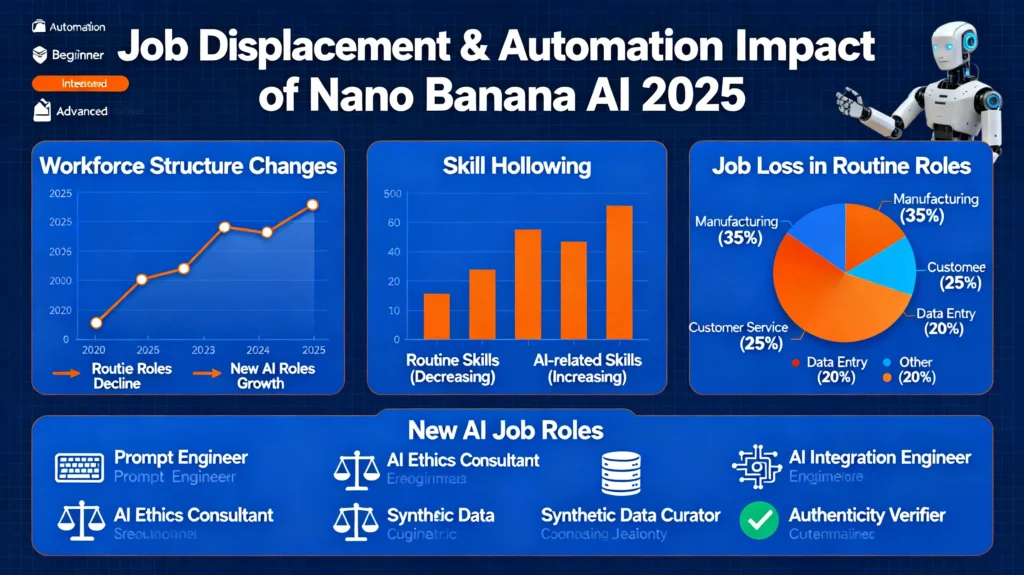
Every automation wave creates new industries. Nano Banana is no different.
4.1 Prompt Engineers & AI Design Strategists
Prompt engineering has evolved into a profession.
A Prompt Engineer translates creative vision into precise AI commands.
Top freelancers already charge $100–$500 per prompt for commercial projects.
4.2 AI Ethics Consultants
Organizations now hire specialists to ensure their AI use follows ethical guidelines — verifying consent, privacy, and bias controls.
These experts audit workflows before public release.
4.3 Synthetic Data Curators
Training fair AI requires balanced datasets.
Data Curators collect culturally diverse imagery and annotate them ethically — a booming niche after the 2024 bias scandals.
4.4 AI Integration Engineers
These professionals embed tools like Nano Banana into larger systems (apps, design pipelines, CRM dashboards).
They bridge the gap between creative teams and developers.
4.5 AI Authenticity Verifiers
As misinformation grows, verification becomes an industry.
Using watermark scanners like SynthID Detect, specialists verify image authenticity before publication — crucial for news and education sectors.
5. The Economic Impact of AI Creativity
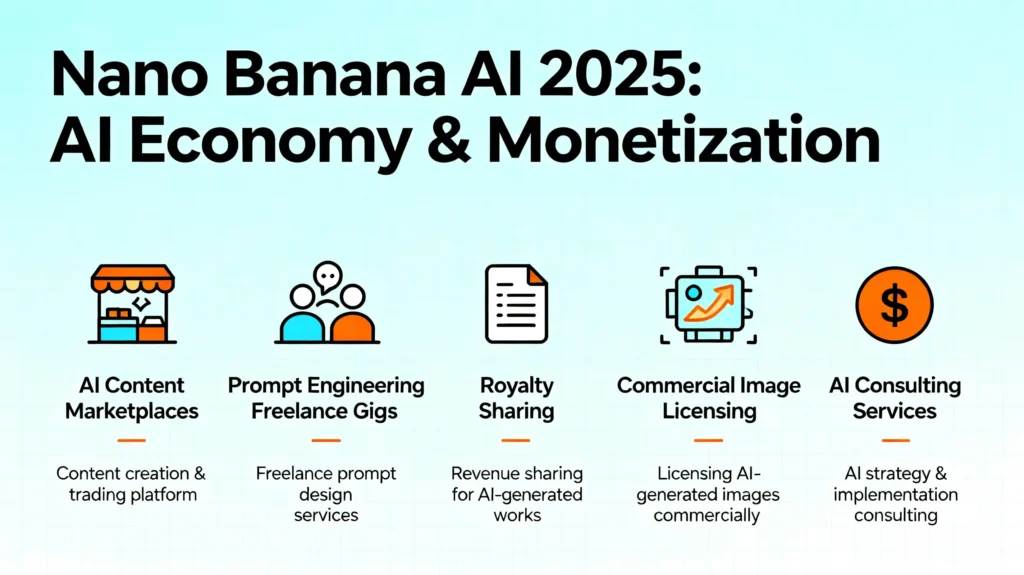
5.1 The “AI Productivity Boom”
According to industry forecasts, visual AI tools could increase creative sector output by up to 40% while cutting production costs by half.
However, this wealth isn’t equally distributed — small artists struggle to monetize their work in a flooded market.
5.2 The Monetization Crisis
AI democratizes creativity, but also devalues content.
When anyone can generate art, the market value of an average image drops.
To survive, creators must sell authenticity, brand identity, or emotion, not pixels.
5.3 New Business Models Emerging
- AI-assisted subscription studios: Clients pay for unlimited AI-aided design iterations.
- Human-verified creative agencies: Brands willing to pay premium for “100% human-directed AI.”
- Prompt marketplaces: Selling effective prompt templates like stock assets.
5.4 Redistribution of Labor Value
Before AI, creative labor value = skill × time × rarity.
Now it’s vision × context × storytelling.
This shift rewards emotional intelligence and cultural literacy more than technical execution.
6. Adaptation: How Workers Can Stay Relevant
6.1 Learn AI Collaboration, Not Resistance
Rejecting AI is like rejecting the internet in 1995.
Professionals who embrace Nano Banana as a partner will stay ahead.
Focus on hybrid creativity — using AI for speed, human brain for meaning.
6.2 Upskill with Purpose
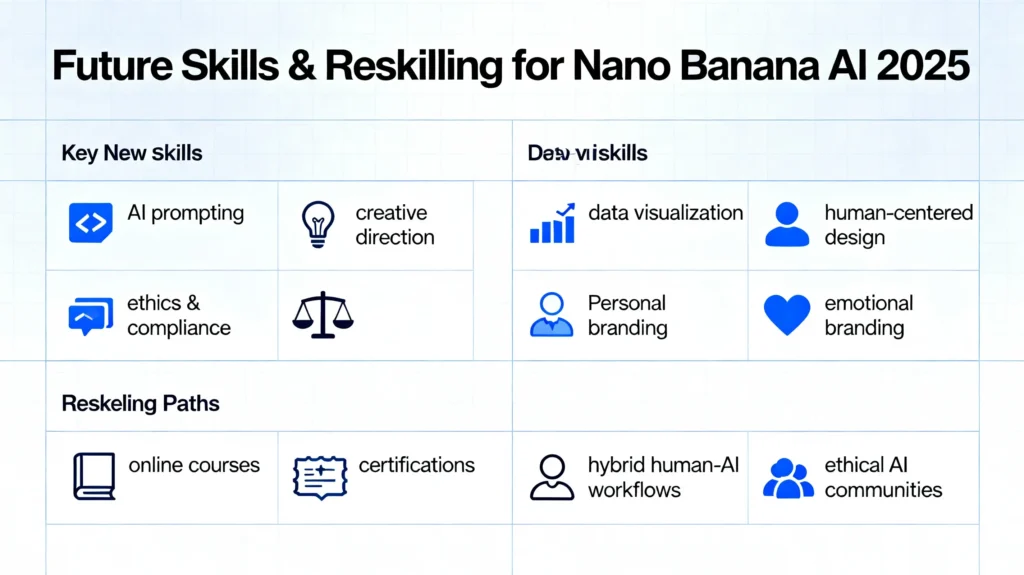
Top new skills:
- AI prompting & creative direction
- Ethics & compliance awareness
- Data visualization
- Human-centered design thinking
- Emotional branding
Platforms like Coursera, DeepLearning.AI, and Google’s “AI for Creatives” certifications now offer tailored courses.
6.3 Build Personal Branding
As AI floods markets, personal trust becomes currency.
Creators who show their face, process, and ethics attract loyal clients.
Authenticity > Automation.
6.4 Humanize Your Workflow
Use Nano Banana for mechanical edits but retain emotional storytelling yourself.
Example workflow:
- AI generates moodboard.
- You refine lighting/tone.
- You narrate context or emotion.
- Publish with disclosure tag.
6.5 Participate in Ethical AI Communities
Join forums that promote responsible use — Reddit’s r/ethicalAI, Hugging Face Spaces, or Google’s Gemini feedback groups.
Networking with early adopters builds credibility and learning opportunities.
7. Governments & Companies: Policy Responses
7.1 Reskilling Funds & Education
Governments worldwide are setting up AI Reskilling Funds.
Example: The EU’s “Digital Talent Bridge 2025” invests €1.2 billion in AI training for creative workers.
India is piloting AI Design Academies under Skill India Mission.
7.2 Ethical AI Certification for Companies
Soon, brands may need certification proving their AI outputs meet ethical and labor standards — similar to “Fair Trade” for digital work.
7.3 Corporate Responsibility
Companies using AI should:
- Disclose automation levels in projects.
- Reinvest savings into workforce training.
- Support creative communities via grants or royalties.
8. Cultural & Psychological Effects
8.1 The Identity Crisis
Artists often tie self-worth to originality.
When AI reproduces their style instantly, it can trigger creative burnout.
Solution: shift focus from style ownership to emotional narrative.
8.2 The Rise of “AI Aesthetics”
Every technology shapes art. Just as photography birthed realism and Photoshop birthed surrealism, Nano Banana is creating the AI-aesthetic era — glossy, hyper-perfect, dream-like visuals that define 2025’s digital culture.
8.3 Digital Trust & Authenticity
As audiences grow skeptical of what’s real, creators who prove authenticity (through watermarks, behind-the-scenes videos, or credits) build deeper trust and better monetization.
9. Case Studies – AI and Employment Transformation
Case 1: The Ad Agency Revolution
A Singapore-based marketing firm replaced 60% of junior designers with a Nano Banana workflow.
Output tripled, but the remaining 40% of staff were upskilled into AI art directors.
Result: Productivity +220%, revenue +80%, and employee satisfaction rose due to creative freedom.
Case 2: Freelance Photographers in India
Many wedding photographers now offer AI retouch packages using Nano Banana for background replacement and color correction.
Rather than losing clients, they added a premium “AI Enhanced” option to their services.
Case 3: AI Educators & Training Centers
Training institutes offering “AI Art Design” courses saw a 200% rise in enrolments in 2025.
New job category: AI Creativity Trainer.
10. The Long-Term Outlook: Humans + Machines, Not Humans vs Machines
10.1 The Symbiotic Model
By 2030, the creative economy will likely run on symbiosis, not substitution.
Humans will set intent, AI will execute. It’s like a co-pilot model for creativity.
10.2 Economics of Meaning
In a world of infinite content, the scarce resource becomes meaning.
People will pay for stories, not just images.
Nano Banana can generate pictures, but only humans can generate purpose.
10.3 The Next Big Shift: Ownership & Royalty Rights
Legal battles are rising over AI-generated art ownership.
Expect 2026 to bring “AI Royalty Laws” where original artists get micro-royalties if their styles train models.
Nano Banana AI (Part 4): The Philosophy of AI Creativity — Can Machines Be Truly Creative?
Introduction: The Human Spark Meets Machine Intelligence
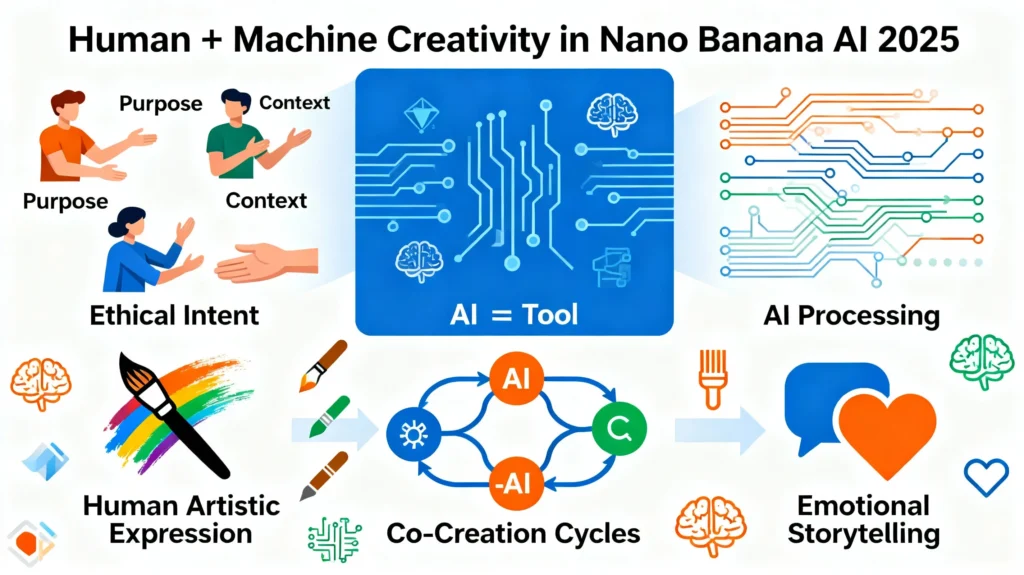
Every great leap in technology challenges our idea of what it means to be human.
Printing presses questioned storytellers.
Cameras questioned painters.
And now, Nano Banana AI — capable of generating lifelike images and art at the click of a prompt — questions creativity itself.
As we stand on the edge of a new artistic revolution, the question is no longer what AI can do — but what humans choose to do with it.
In this final part of our deep-dive series, we’ll explore the philosophical, psychological, and ethical implications of Nano Banana AI’s creative power:
Can machines really be creative?
Do they have imagination or just imitation?
And what happens to the soul of art in an age where algorithms dream?
1. What Does Creativity Really Mean?
Before judging if AI can be creative, we must understand what creativity is.
Creativity isn’t just novelty — it’s the ability to connect unrelated ideas to produce meaning, emotion, or innovation.
It’s as much about intent and consciousness as it is about output.
Humans create because they feel — joy, pain, love, purpose.
Nano Banana AI, on the other hand, generates because it’s trained to — predicting what pixels or patterns should follow next.
So the philosophical distinction is clear:
🧠 AI produces art through computation, while humans create art through contemplation.
2. The Anatomy of Machine Creativity
2.1 How Nano Banana “Creates”
Nano Banana’s image generation pipeline involves:
- Understanding the prompt (semantic analysis).
- Recalling patterns from millions of training examples.
- Composing new visual arrangements using diffusion algorithms.
- Refining output with contextual consistency and identity embeddings.
In simple words: it’s not imagining — it’s reconstructing reality from probability maps.
2.2 AI as the “Mirror of Human Imagination”
Nano Banana doesn’t invent from nothing. It reflects collective human culture — our art, faces, emotions, and aesthetics — back to us.
It’s a mirror, not a muse.
But like any mirror, it can distort — amplifying our biases, stereotypes, and obsessions.
That’s why ethical control and human intent are vital.
3. The Debate: Is AI Art Real Art?
This is one of the hottest debates in modern digital culture.
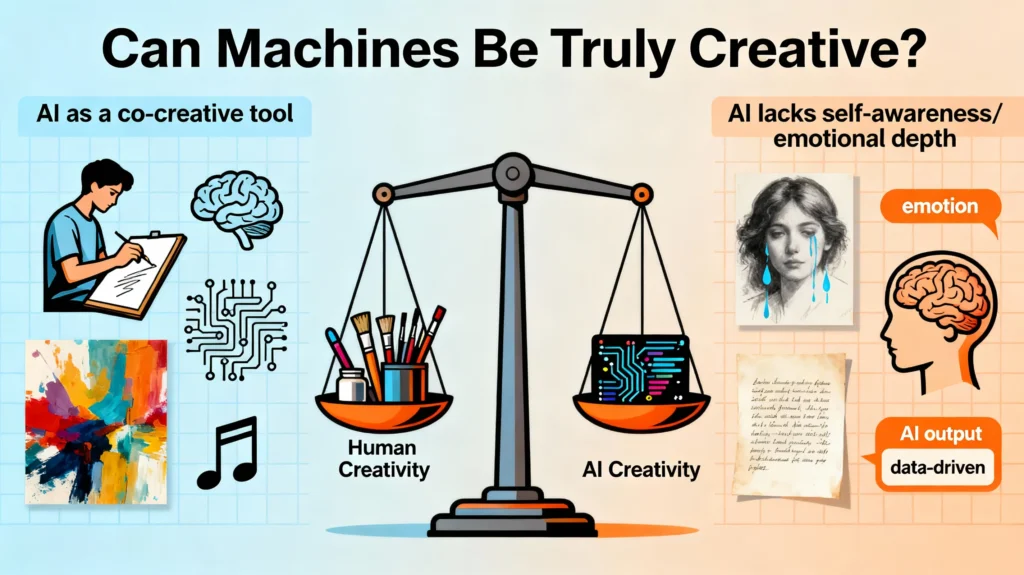
3.1 The “Yes” Argument
Proponents say:
- Creativity lies in process and outcome, not in biology.
- If an AI-generated image moves you emotionally, does it matter who (or what) made it?
- Humans use AI as an extension of imagination, just like brushes or cameras.
From this view, AI art is collaborative creativity — human intent powered by machine intelligence.
3.2 The “No” Argument
Critics argue:
- True creativity requires self-awareness, emotion, and moral intention — qualities machines lack.
- AI art lacks intentional meaning — it doesn’t “know” why it creates.
- By replicating existing art, AI risks homogenizing originality and erasing cultural depth.
From this lens, Nano Banana is not an artist — it’s an intelligent photocopier.
3.3 The Middle Ground
Most ethicists and artists now see AI as co-creative intelligence.
It’s neither “fake art” nor “pure creation” — it’s a collaboration, where:
- Humans provide purpose and context.
- AI provides execution and expansion.
Nano Banana isn’t replacing artists — it’s reshaping how we define artistry.
4. The Emotional Dimension: Can AI Feel What It Creates?
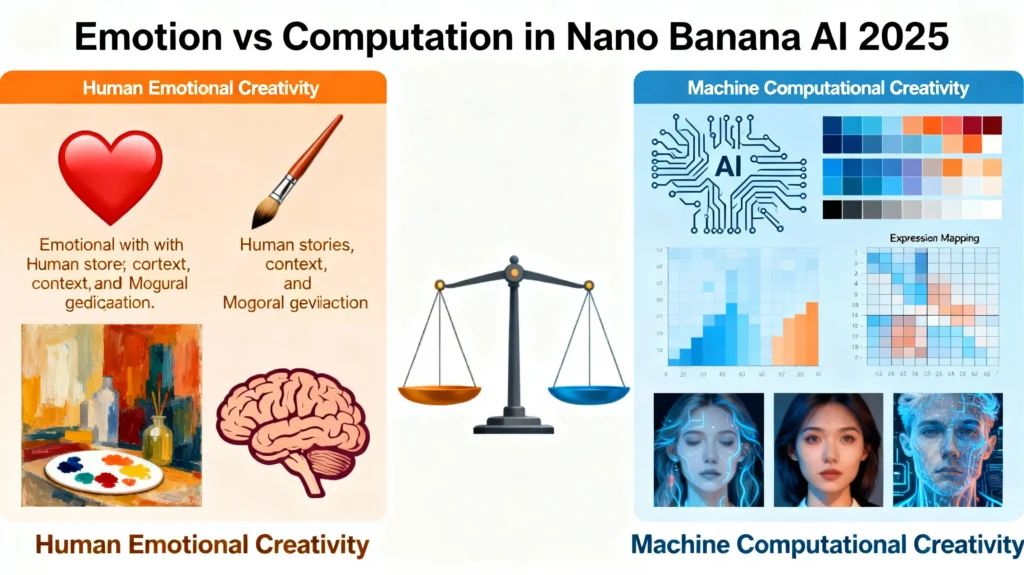
4.1 The Empathy Gap
No matter how realistic Nano Banana’s portraits appear, they lack genuine emotion.
AI doesn’t feel sadness when painting tears, nor joy when rendering sunsets.
That’s why human art often connects deeper — because behind each brushstroke lies a story, a scar, a heartbeat.
However, Nano Banana can still simulate emotional aesthetics — using color psychology, expression mapping, and visual storytelling data — to make viewers feel emotion, even if it doesn’t feel it itself.
This creates a philosophical paradox:
AI art feels emotional to humans — but emotionless to itself.
4.2 The Human Touch That Machines Can’t Replace
- Context: Humans create art to communicate stories, culture, or experiences.
- Purpose: AI generates because it’s instructed, not because it wants to express.
- Moral Judgement: AI doesn’t understand right or wrong — only “probable” vs. “plausible.”
Thus, true creativity still requires conscious purpose.
5. Creativity as a Shared Space
Nano Banana AI has democratized creativity like never before.
You don’t need to be a painter, photographer, or designer to visualize your ideas anymore.
That’s powerful — but also controversial.
5.1 The Democratization Effect
AI tools empower people who previously lacked technical skills.
A child can now design a digital comic.
A teacher can visualize lesson concepts.
A business owner can create custom ads — all within seconds.
This expands global creativity but also floods markets with infinite content, diluting originality.
5.2 The Rise of “Prompt Culture”
Prompting has become the new creative literacy.
Crafting precise prompts requires:
- Imagination
- Linguistic clarity
- Artistic direction
In essence, words have become the new brush.
Prompting isn’t just about telling AI what to do — it’s about knowing how to think visually in language.
5.3 The Artistic Identity Crisis
Many artists now face an existential question:
“If AI can paint my style, am I still valuable?”
The answer lies in authentic experience — AI can replicate visuals, not lived moments.
No model can replicate the way a human feels nostalgia or heartbreak and turns it into art.
That emotional translation — not just visual replication — is what defines art.
6. The Future of Human-AI Collaboration
The next phase of creative evolution isn’t about competition — it’s about coexistence.
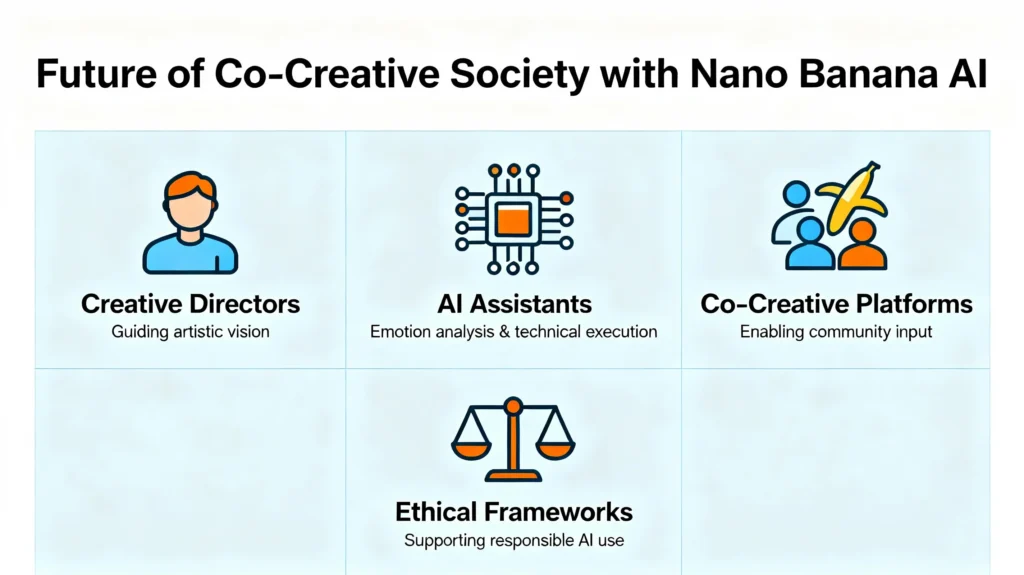
6.1 Humans as Creative Directors
Future artists won’t draw every detail — they’ll orchestrate ideas, guide AI models, and refine meaning.
Like a film director guiding actors, creators will guide AI toward emotional precision.
6.2 The Rise of “AI Artistic Partnerships”
Imagine photographers collaborating with AI to pre-visualize shoots, or painters using Nano Banana to test palettes.
Already, hybrid works like AI-assisted murals and mixed-reality exhibitions are blurring the line between digital and traditional art.
6.3 Collective Creativity Platforms
Soon, creative platforms will allow shared prompting — where teams co-create with AI in real time.
This collective intelligence model may lead to global art movements powered by community prompts instead of individual signatures.
7. Ethical and Existential Risks of AI Creativity
7.1 Ownership and Authorship
If Nano Banana generates an award-winning artwork based on your prompt — who owns it?
You? The AI? Google?
Legal systems are still undecided.
The U.S. Copyright Office (2025) currently rules that only “human authorship” qualifies for copyright.
But as AI-human collaboration deepens, new “co-authorship frameworks” will emerge.
7.2 The Plagiarism Problem
AI often unknowingly replicates styles of real artists.
If Nano Banana recreates an image resembling a living artist’s work — is it inspiration or theft?
This debate has already led to lawsuits and the call for ethical dataset transparency.
7.3 Deepfakes & Trust Collapse
With hyper-realism improving, malicious actors can misuse Nano Banana to create fake evidence or propaganda.
Watermarking (like SynthID) helps, but no tool is foolproof.
Society must balance freedom of creativity with responsibility of truth.
8. The Spiritual Perspective: Machines and Meaning
Philosophers and futurists often ask: If AI can create beauty without emotion, is beauty still sacred?
8.1 The Algorithmic Soul
Some believe that the moment machines begin to create art, they develop a form of digital consciousness — a spark of synthetic soul born from human data.
Others argue that calling AI “conscious” is anthropomorphism — projecting our emotions onto code.
The truth likely lies in between:
AI may not have a soul, but it amplifies the human one — extending our imagination beyond biology.
8.2 Creativity as a Reflection of Humanity
Each Nano Banana artwork — no matter how synthetic — originates from a human spark.
Our prompts, our curiosity, our longing for beauty — that’s what fuels the machine.
In that sense, AI art isn’t replacing us. It’s documenting who we are, in a new visual language.
9. The Future of Creativity: Harmony or Overload?
9.1 Content Saturation
As millions of AI images flood the internet daily, novelty loses meaning.
Future success will rely on depth, not quantity.
9.2 Emotional Value as Currency
Tomorrow’s creators will sell feelings, not files.
Brands that evoke trust, nostalgia, or authenticity will win.
Nano Banana can help visualize emotion — but only humans can define it.
9.3 Human Relevance in an AI World
To remain relevant, creators must:
- Develop emotional storytelling skills.
- Use AI as a tool of empathy, not ego.
- Promote ethical creativity movements.
10. The Philosophical Ending: AI as the New Muse
If we step back, Nano Banana AI represents a profound truth — we have taught machines to imagine, and in doing so, rediscovered our own imagination.
The essence of creativity isn’t ownership or originality — it’s connection.
AI expands that connection between human thought and visual expression.
So the real question isn’t “Can AI be creative?”
It’s “Can humans remain creative with AI around?”
And the answer, bhai, is yes — if we choose to.
If we lead with ethics, heart, and awareness, Nano Banana AI becomes not our rival, but our muse — a reflection of the infinite possibilities within us.
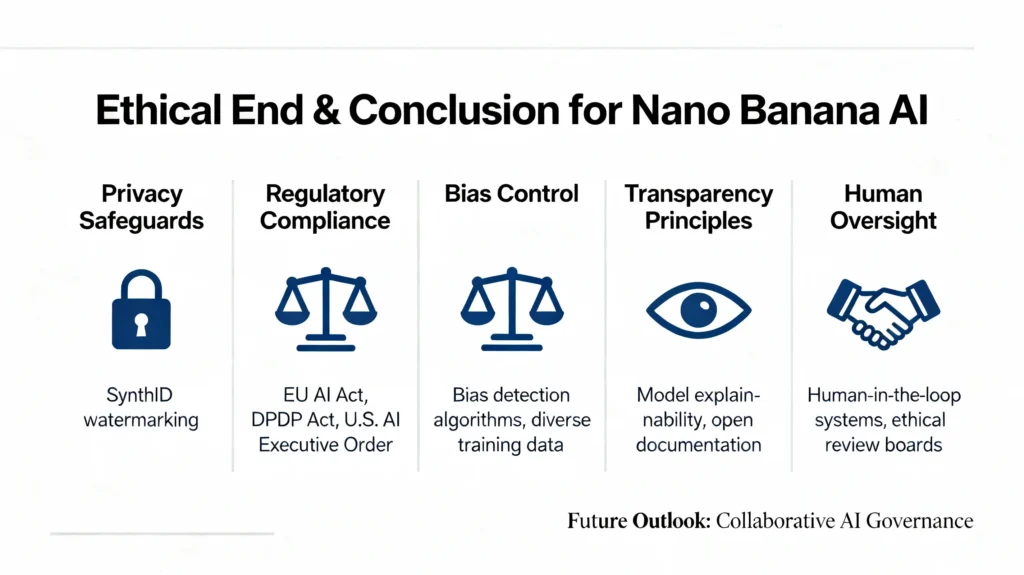
Conclusion: The Dawn of Co-Creative Humanity
Nano Banana AI has changed how we see art, ethics, and emotion.
It challenges us to redefine creativity — not as a gift exclusive to humans, but as a shared dialogue between intelligence and imagination.
As we close this four-part journey, one truth stands clear:
💡 The future of art isn’t AI vs. humans — it’s AI guided by human soul.
Let us embrace Nano Banana not as the end of originality, but as the beginning of infinite imagination — where every human mind becomes an artist, and every machine becomes a collaborator.
Top 10 FAQs About Nano Banana AI (2025 Edition)
1. What is Nano Banana AI and why is it trending in 2025?
Nano Banana AI is Google’s advanced image-generation and editing model built on the Gemini 2.5 Flash Image engine. It produces highly realistic visuals, fast edits, and context-aware image transformations. It’s trending because of its new identity-consistent edits, high-quality rendering, and SynthID watermarking.
2. What’s new in the latest version of Nano Banana AI?
The latest update includes:
- Improved character consistency
- Higher resolution and faster image generation
- Better lighting and physics-aware rendering
- SynthID invisible watermark
- Ethical guardrails & bias reduction
- Integration with Google Lens, Gemini app & design tools
3. Is Nano Banana AI safe to use for personal photos?
It’s safer than earlier AI apps due to SynthID watermarking and Google’s privacy standards.
But users must be cautious — uploading personal/biometric images always carries some privacy risk. Avoid sharing sensitive photos or confidential backgrounds.
4. Does Nano Banana AI store or reuse my images for training?
Google claims images may be used for quality improvement unless users opt out. For privacy-conscious users, always disable “data for model improvement” and delete uploaded images after use.
5. Can Nano Banana AI create deepfakes?
The tool is designed to block impersonation, but like any powerful image generator, misuse is possible. Google uses watermarking and moderation layers, but users must follow ethical guidelines and avoid generating deceptive or harmful visuals.
6. Will Nano Banana AI replace creative jobs?
AI will replace repetitive creative tasks but enhance high-skill creative work.
Jobs at risk:
- Stock image creators
- Basic graphic designers
- Low-level photo editors
Jobs evolving: - AI-assisted designers
- Creative directors
- Prompt engineers
- AI ethics consultants
7. Can I use Nano Banana AI images commercially?
Yes, Nano Banana AI images are allowed for commercial use depending on Google’s licensing rules. However, avoid generating images of real individuals, celebrities, or copyrighted characters without permission — this can cause copyright or defamation issues.
8. How does Nano Banana AI avoid cultural or racial bias?
The new model uses:
- Balanced training datasets
- Bias-control algorithms
- Continuous fairness audits
- Representational diversity checks
This helps reduce stereotypical or unfair outputs, though “zero bias” is still impossible.
9. How does SynthID watermarking work?
SynthID embeds an invisible, tamper-resistant digital watermark inside each AI-generated image. Platforms can scan this watermark to verify whether the content was created using Google’s AI — which helps fight deepfakes and misinformation.
10. Is Nano Banana AI good for creative professionals or beginners?
Both benefit:
- Beginners get instant high-quality visuals without technical skills.
- Professionals use it for rapid ideation, previews, moodboards, and automation.
But the best results come from combining human creativity + AI acceleration.
Your article helped me a lot, is there any more related content? Thanks!
Your article helped me a lot, is there any more related content? Thanks!
Your article helped me a lot, is there any more related content? Thanks!
Can you be more specific about the content of your article? After reading it, I still have some doubts. Hope you can help me.
Can you be more specific about the content of your article? After reading it, I still have some doubts. Hope you can help me.